
17 min read
Five Guarantees a Health Check Does Not Cover
Availability, reliability, performance, scalability, and consistency fail independently. A payment API can return HTTP 200 from its health check while authorizations time out, …
Design system engineering · POS · Payments · Security
I’m Vincent Bevia. I work in payments at MultiSafepay (part of Ant Group), and I’ve spent years on design system engineering for POS, payments, and security — architecture, EMV, cryptography, and the infrastructure behind card-present and digital acceptance. I’m the author of Point-of-Sale Systems Architecture and The Obsolescence Paradox.
This site is where I write about payment platforms as systems: channels, orchestration, HSM and tokenisation, acquiring rails, and the ops layer that makes settlement and audit trustworthy. Also AI in payments, and the EE / telecom foundations underneath.
Less corporate, more personal. Opinions, reflections, and the kind of things I’d talk about over coffee.
If you’re into payment platforms, POS, or security architecture — or just curious how the pieces fit — welcome.
Latest field notes
Availability, reliability, performance, scalability, and consistency fail independently. A payment API can return HTTP 200 from its health check while authorizations time out, …

Linearizability, causal order, isolation, and eventual convergence answer different questions. A payment platform has to attach a guarantee to each operation, including the …

OWASP ranks broken object-level authorization first. This post orders HTTP API controls by the failure they stop, for payment and platform systems.

Using Lifecycle Ownership to Decide When a Monolith Should Be Split

A practical architecture for safe payment retries, durable scheduling, duplicate-tolerant messaging, and reconciliation.
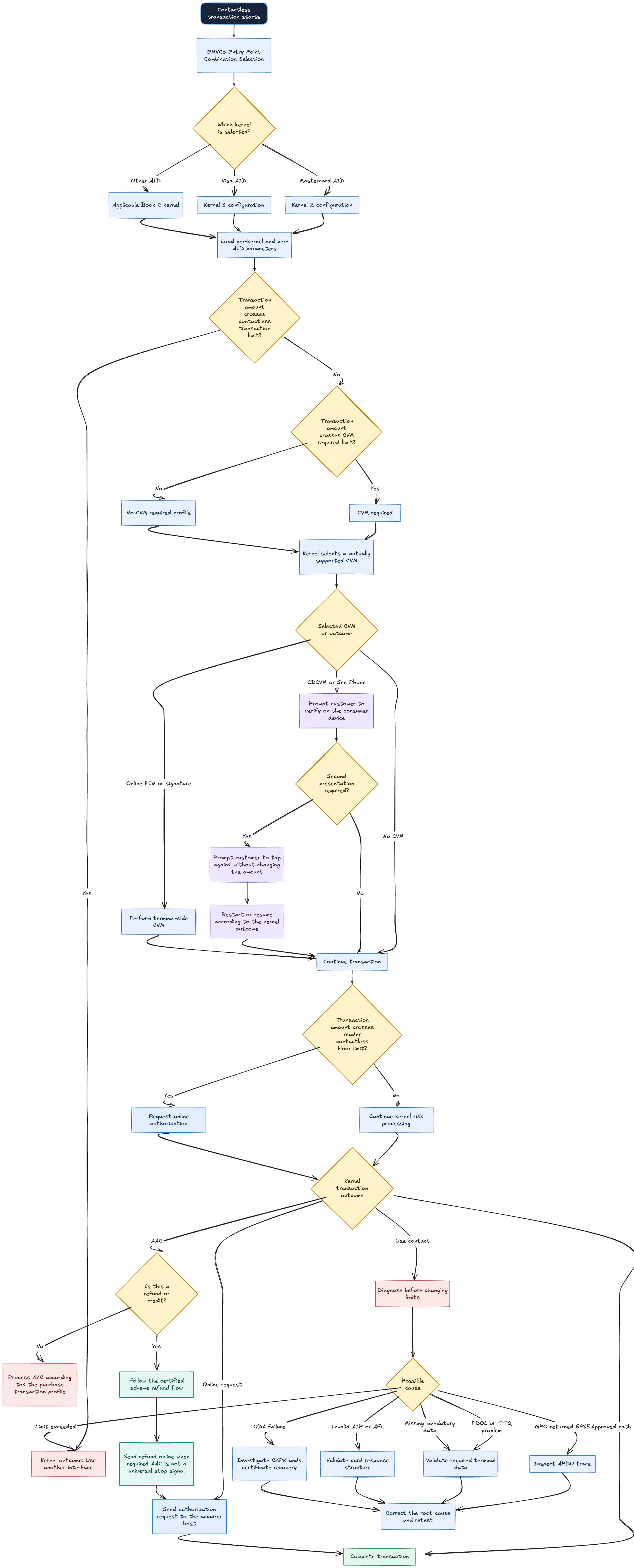
The earlier post, Contactless EMV Integration: Limits, CDCVM, Interface Switching and Refunds, treats one collapsed “contactless limit” as the wrong problem class. The reader …

A card-present authorization can leave the terminal, succeed at the issuer, and never return. Collapsing that path into approved or declined is how partial amounts ship goods, …

A card-present payment is a sequenced protocol, not a function call. Who owns each stage from amount entry to settlement, and why collapsing the sequence into approved or declined …

A payment timeout tells you that an answer did not arrive. It does not tell you whether money moved. That uncertainty exists with a single server: the payment can complete and the …

Session polling is a workable way for a payment terminal to ask whether work exists. It becomes a poor primary mechanism when many devices repeatedly read an unchanged session, …